


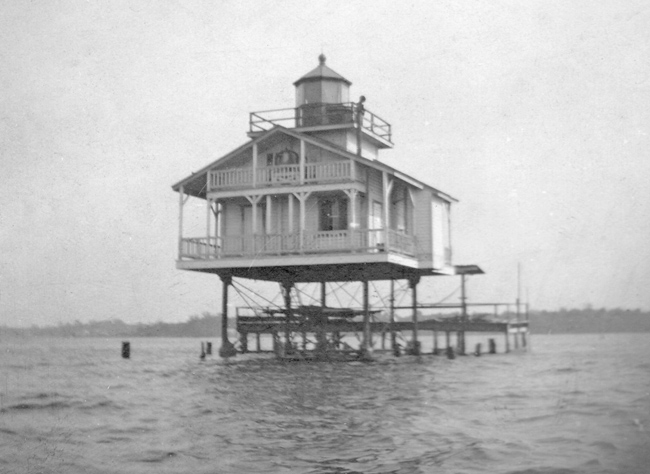
A screw-pile lighthouse is a tower which stands on metal piles screwed into sandy bedrock on the sea, the land, and either river or even lake bottoms. The first screw-pile was built by the equally amazing blind Irish engineer Alexander Mitchell. It was called the Maplin Sands Light at the mouth of London’s Thames River in 1841. In the United States, the screw-pile answered the many needs for lights to be placed in unusually difficult places like Chesapeake Bay due to its estuarial nature, and North Carolina’s sounds and river entrances. America’s first screw-pile lighthouse was at Brandywine Shoal in Delaware Bay, an area served by a lightship since 1823. The screw-pile, built in 1828, was destroyed by ice the same year.
Screw-piles became especially popular among lighthouse engineers for the south, especially Florida, after the Civil War. They were easy to construct, relatively inexpensive and pretty quick to build. They were also the tower of choice by the Lighthouse Board to replace lightships and light vessels inside bays, sounds, rivers and lakes, oh and let’s not forget the Florida Keys! The sea bottom is soft coral rock and for that, the screw-pile end had a flat cast iron or steel disk-like flange or shoulder which rested on the bottom. The disk distributed the weight of the tower and further anchored it.
Out of the 51 lighthouses Florida once had, 19 were screw-pile lights on land or at sea.
And, of course, our third Volusia County lighthouse was a classic screw-pile called the Volusia Bar Lighthouse and located in Lake George in western Volusia County. Its construction was likewise supervised by Major Jared Smith who took over the construction of the Mosquito/Ponce Inlet Lighthouse at the death of General Babcock. The Volusia Bar continued in operation until 1908.