


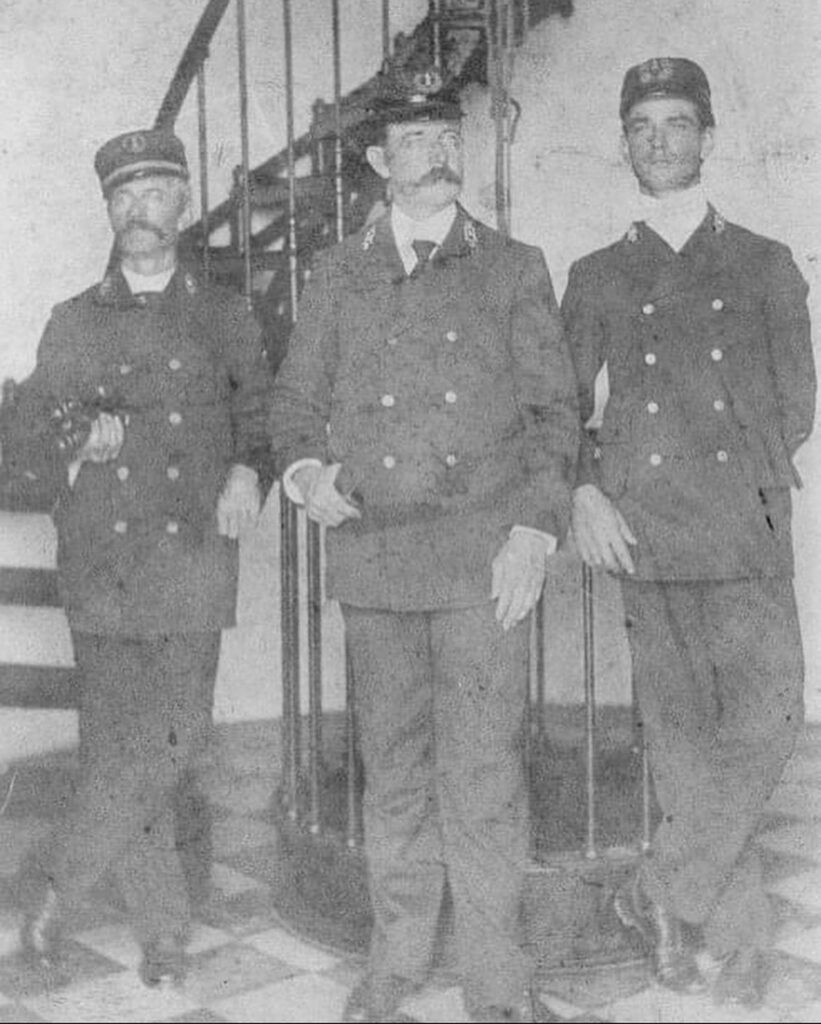
In 1887, Principal Keeper William Rowlinski, was paid $720 a year Two year later, he got a raise to $760. The extra pay was to compensate for the fact that quarterly visits by the US Lighthouse Establishment tenders no longer brought supplies, and he had to arrange for food and supplies himself.
Salary scales were not necessarily representative on performance, but on the difficulties in accessing the job itself, and whether or not the keeper’s family could accompany him living at the station.
Some keepers were alone at a station and worked every day They had to hire help if needed, and the compensation for help came out of the keeper’s salary.
In 1896, Civil Service finally set the pay and governance for appointments and advancement for keepers on a merit basis. By 1900, the pay for assistant keepers was either $50 or $55 per month.
By 1918, the Bureau developed seven classes of lighthouse stations to determine keeper’s pay. These classes were determined by location. There were six “classes” of pay depending on specific living arrangements ranging from stations where families were not allowed to live on, and the difficulty for keepers to “get aboard.” Descending in difficulty were stations off shore with families living ashore; stations on islands far from civilization; moderately difficult stations also with fog stations; located on land near civilization also with fog signals, and the dream stations within a community with schools nearby! Finally, the smallest class was a one-man-station. This usually had the unacknowledged and unpaid assistant, the keeper’s wife!
Keepers also received additional amounts for the degree of difficulty. Finally, in 1916, keepers were compensated for injury on the job, and families received benefits if the keeper died on the job. Some medical expenses were provided for keepers and families at public health facilities. Finally, in 1918, keepers were provided with retirement benefits for keepers 65 and older with 30 years or more of service.